What is a gratitude journal?
A gratitude journal is a place where you write down things you were glad about. That is the whole idea. Most people keep one at the end of the day, write two or three lines, and close it.
It is not a diary. A diary records what happened. A gratitude journal records what was good about what happened, which turns out to be a different act, and a harder one.
What goes in a gratitude journal
Anything you were glad of. People expect it to be big things and it almost never is. A seat on the train. The first cold morning of the year. Someone texting back quickly.
Three things is the usual advice, though there is nothing magic about three. One line you mean beats five you invented.
Most people write:
- something that happened that day
- someone who was good to you
- something you would miss if it were gone
What is the purpose of a gratitude journal?
To make you notice. That is the whole mechanism, and the rest follows from it.
The writing is not really the point. The writing is a device for forcing attention onto something you would otherwise have walked straight past. You cannot write down that the coffee was good without having, for a moment, actually thought about the coffee.
People expect the purpose to be a mood lift, and that does happen, modestly. The more reliable effect is on what you notice during the day. After a few weeks of looking for one good thing each evening, you start spotting them in the afternoon, because some part of you knows it is going to be asked.
There is a second purpose that nobody mentions at the start, because it only arrives later. The journal becomes a record. A year in, the thing you own is not the habit. It is the archive.
How to start a gratitude journal
Pick a time you are already still. Most people choose the end of the day, in bed, because that is when the day is finished and you can see the shape of it.
Write one thing. Not three, not a page. One.
Then do it again tomorrow. The whole practice is a habit wearing a nice coat, and habits are built by being small enough to survive a bad week.
What is the 3-3-3 journal method?
This one is worth answering honestly, because a lot of people search for it and the available answers do not agree with each other.
There is no settled 3-3-3 journal method. Search for it and you will find at least three incompatible versions: three things you can see, three you can hear and three you can move, which is a grounding exercise for anxiety and not journaling at all; three things you are grateful for, three you achieved and three you are looking forward to; and three of something written each morning. Most of them trace back to blog posts and app FAQs rather than to any origin.
If you came looking for a structure with something behind it, use three good things. At the end of the day, write down three things that went well, and next to each one, why it went well. The second half is the part people drop, and it is the part that does the work. The why is what turns a list into noticing.
And as above, three is not magic. One you mean beats three you invented.
Does gratitude journaling actually work?
Reasonably well, for what it is.
Gratitude journaling has been studied since the early 2000s, and writing down what you are grateful for is consistently linked to better mood and better sleep. The effects are real and they are modest. It will not fix a hard season of your life, and anyone who tells you it will is selling something.
What the research is clearer about is that the effect comes from attention, not from the list. Noticing something properly is what does the work. Writing it down is mostly a way of making yourself notice.
What to write when nothing good happened
This is the night that ends most gratitude journals, so it is worth answering plainly.
On a bad day the honest entry is often very small. The coffee was hot. It stopped raining. You got through it.
That is not a failure of the practice. That is the practice. The skill you are building is finding the good thing when it is not obvious, and a day where it is not obvious is the day you get to practise it.
You are also allowed to skip a night. A journal you return to after missing a week is worth more than one you abandoned because you broke a streak.
Why use an app?
Knowing what a gratitude journal is has never been the hard part. Keeping one going past the second week is.
That is the part an app is for. The pieces that make the difference:
- A reminder at the right hour. Not a nag in the morning. One at the time you are already winding down, which is the only time you can answer it honestly.
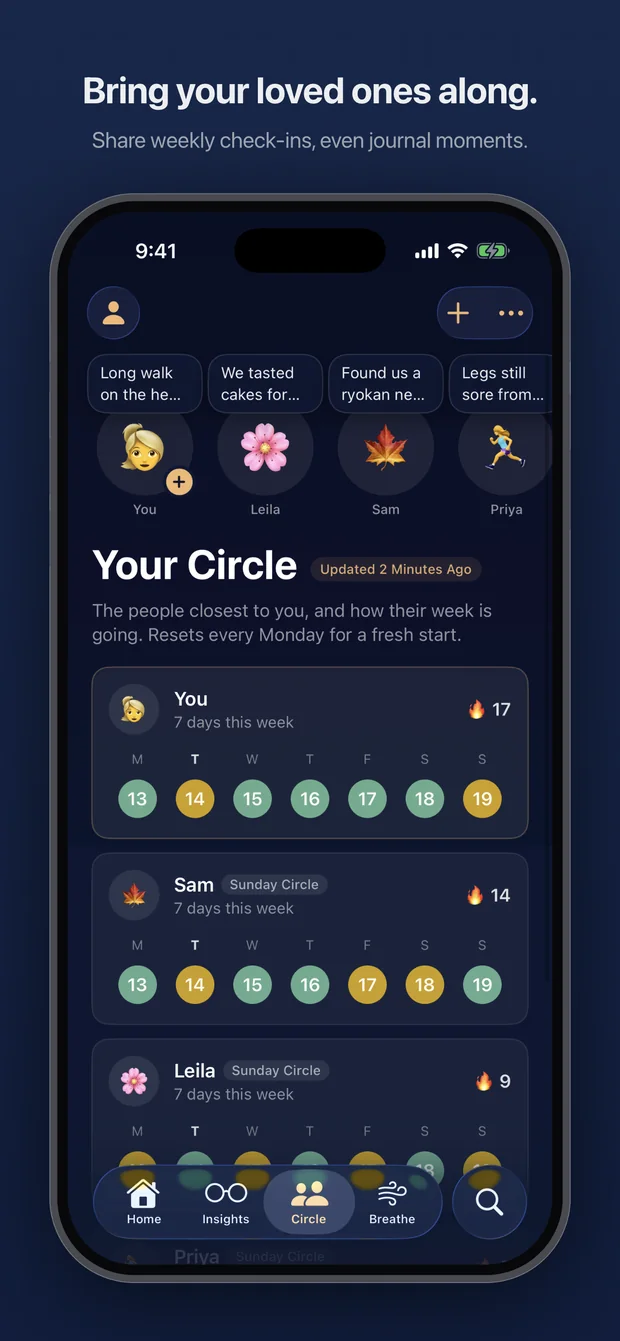
- Somewhere to see how the week is going. Knowing you have written three nights out of seven is what gets you to write on the fourth. It matters more than it should.
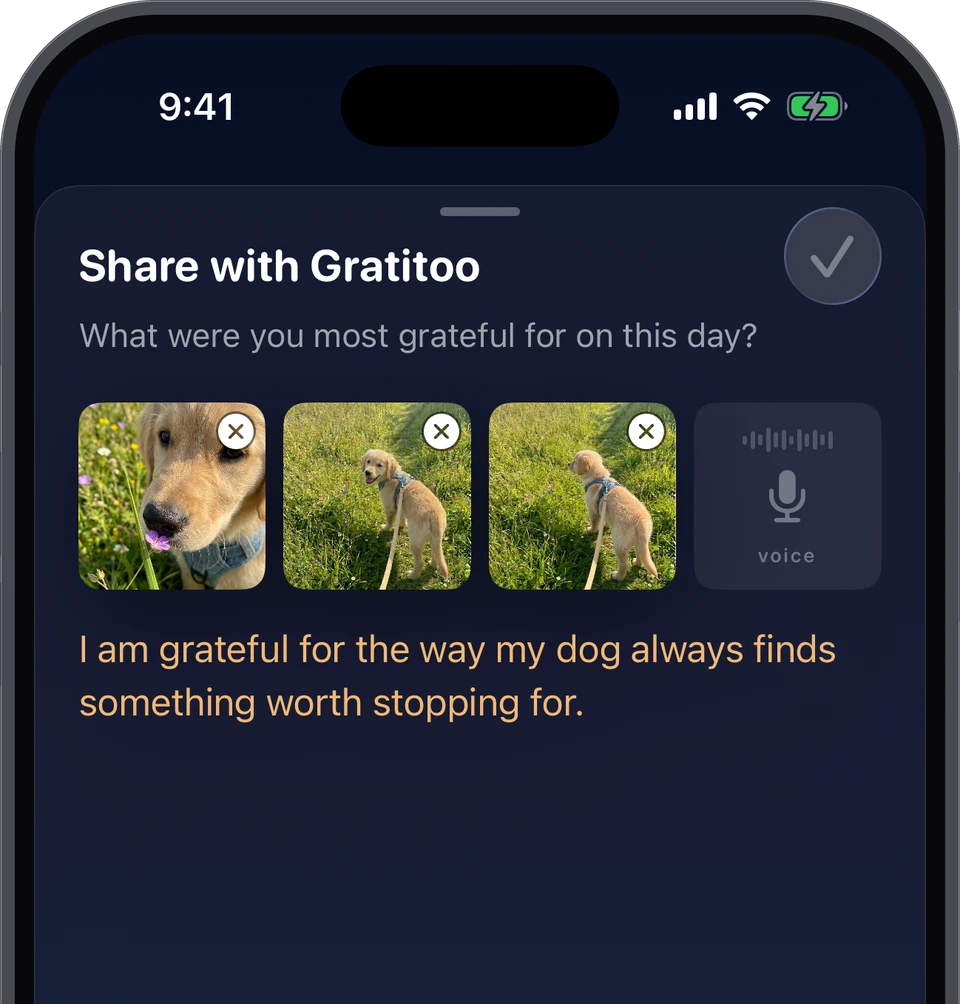
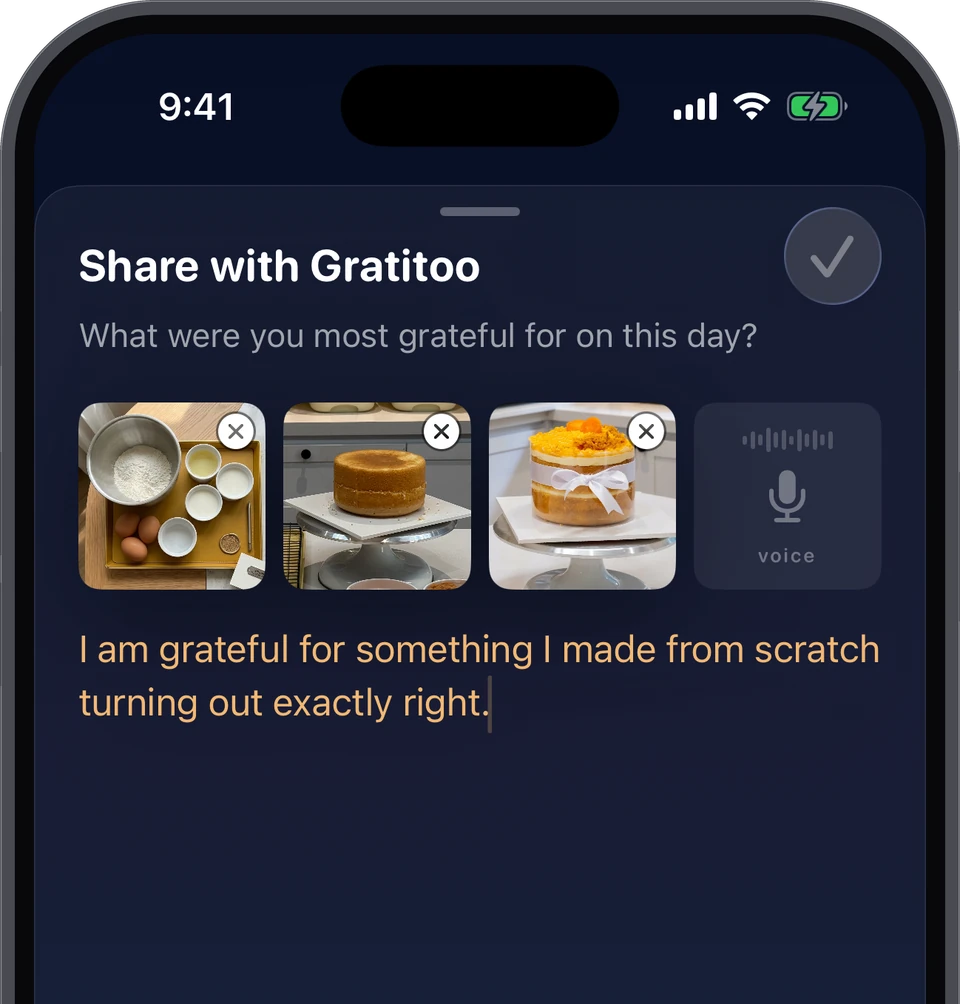
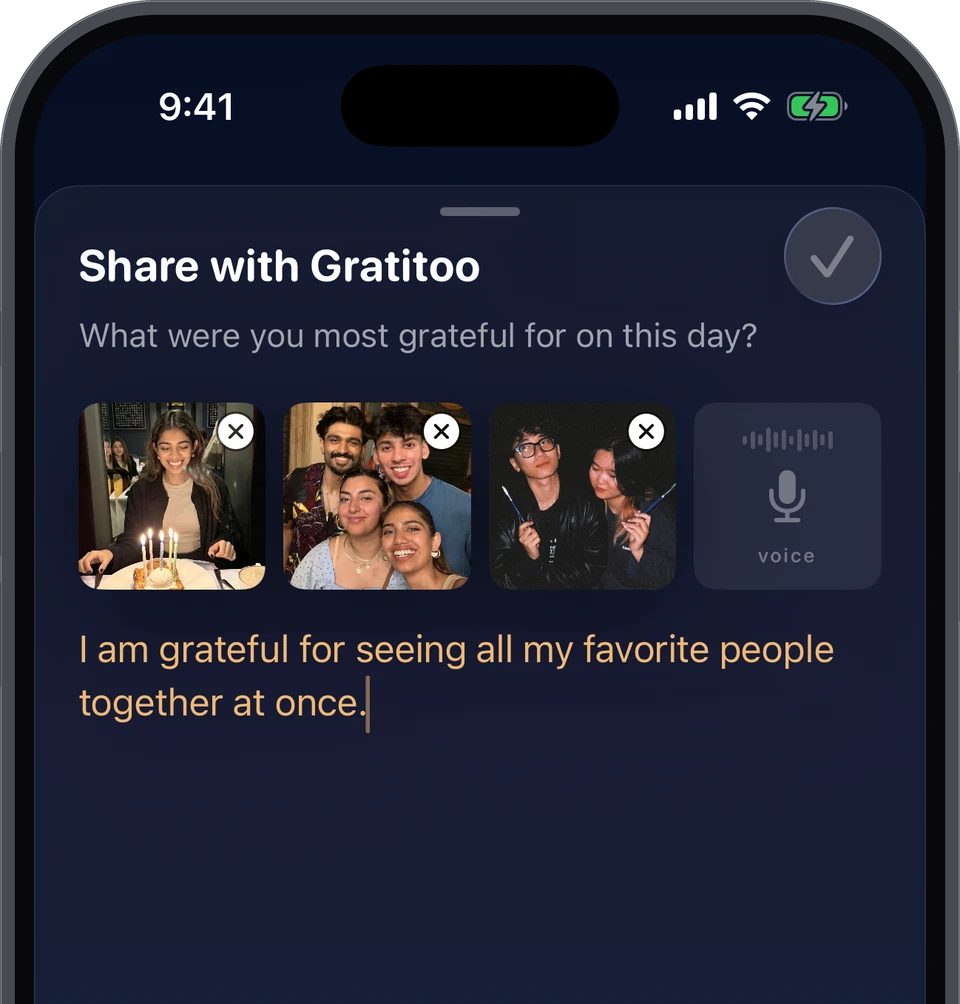
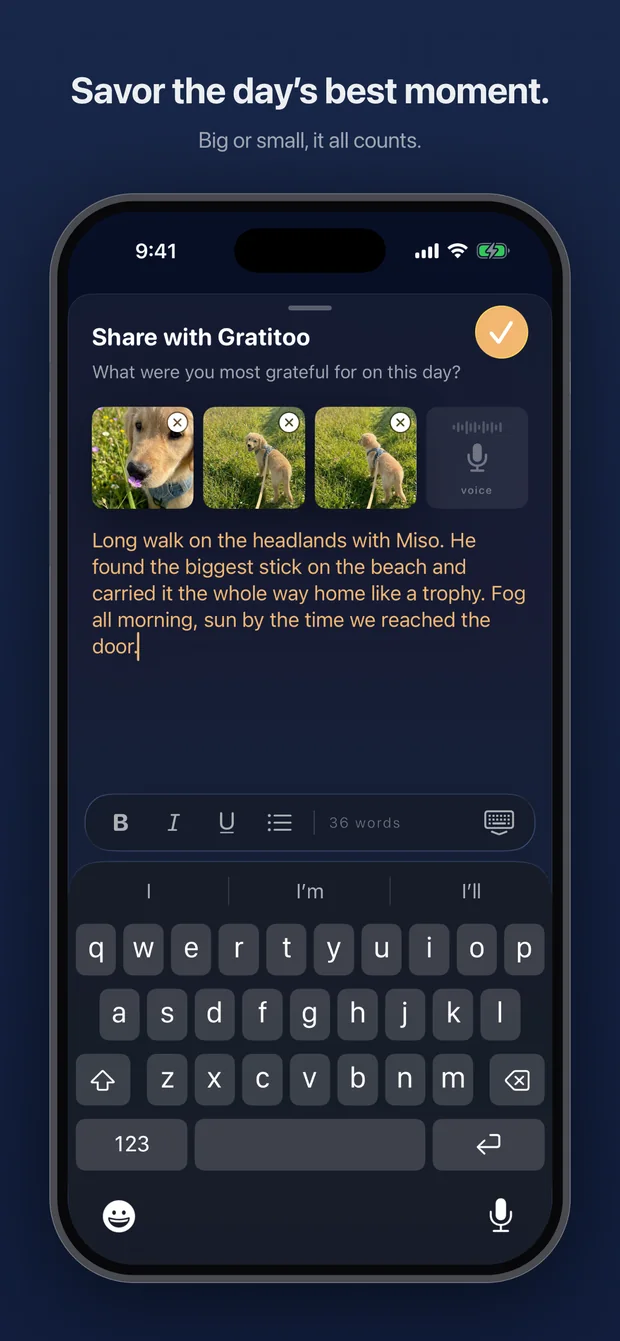
- Photos. You already took a picture of the thing you were glad about. Keeping it with the entry means you get the moment back later, and not just the sentence about it.
- Your voice. Some nights you do not want to type. Saying it out loud is a lower bar, and a lower bar is the whole point.
- A few other people. A private habit is easy to drop. Letting a small circle see an entry, or just see that you checked in this week, makes it harder to quietly stop.
- What you wrote a year ago. This is where most of the value hides. An entry you had forgotten, handed back to you on the day you wrote it.
The thing worth checking before you pick one is where what you write is kept, and whether anything reads it. We read 4,914 App Store reviews of gratitude journal apps to find out what actually goes wrong with them, and losing your entries came up far more often than running out of things to write.
If you want a hand with it


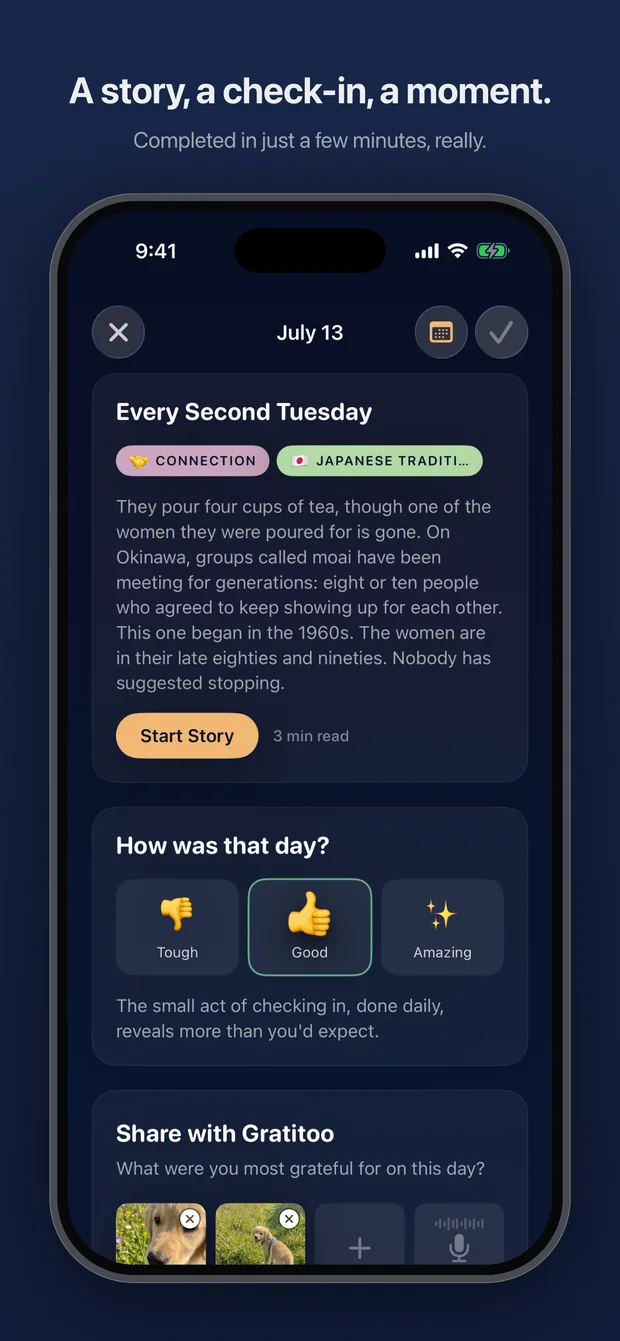
Fall in love with the life you already have. Savoring is the research-backed skill of noticing one good moment every day.